


Moody's Website Redesign
Introduction
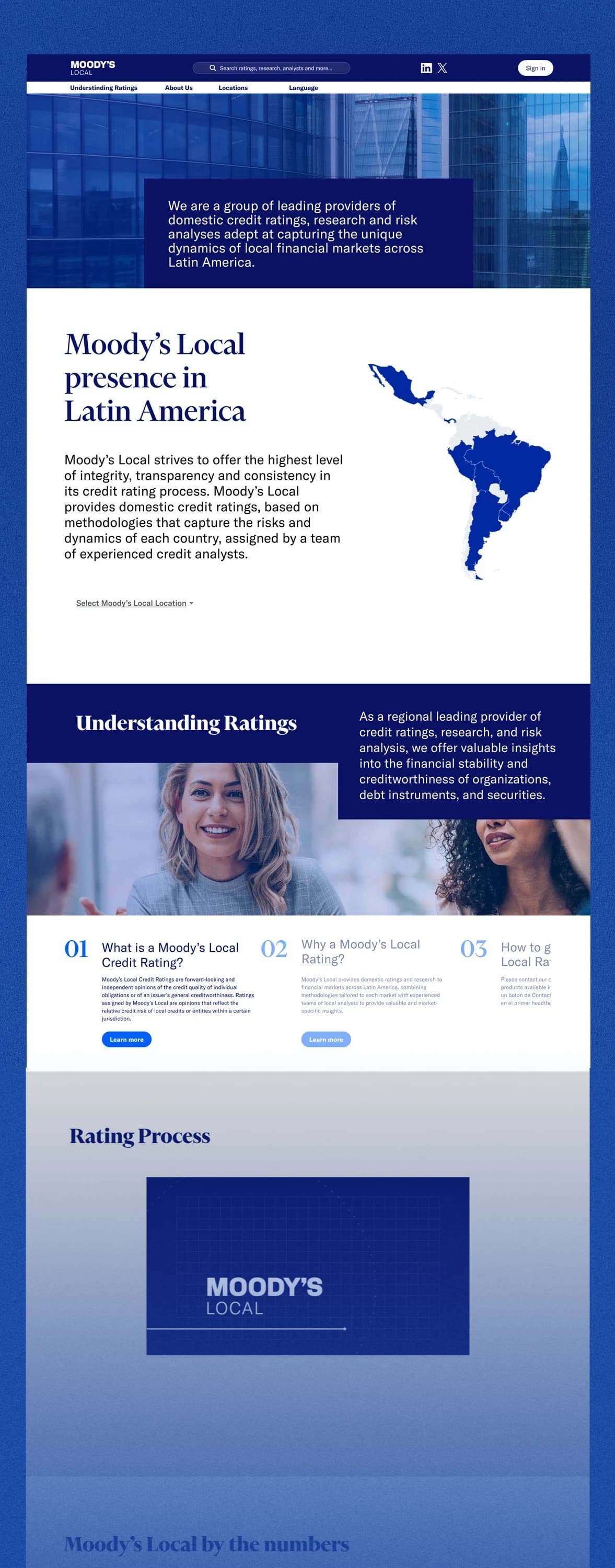
This project entailed designing and engineering the digital web platform for Moody's Latin America, aligned with the global brand revitalization of one of the world's most reputable credit rating and data analytics organizations. The mandate was to translate global brand guidelines into a modern, cohesive digital experience optimized for the regional enterprise ecosystem. The scope centered on engineering a crisp, accessible, and high-performance interface that respects Moody's new visual standards while guaranteeing intuitive user journeys. Every component was engineered to project confidence, institutional authority, and transparency—principles that have anchored the company for over a century.
About the Client
Moody's is an international benchmark in risk assessment, market intelligence, credit ratings, and financial data tools serving corporations, sovereign institutions, and capital markets. With over 115 years of operational heritage, the organization empowers decision-makers worldwide with actionable risk insights. The initiative targeted the Latin American geography, adapting global guidelines to regional expectations across multiple diverse industries and financial hubs.
Project Objectives
The overriding goal was to deploy Moody's global rebranding across its regional digital touchpoints, delivering complete coherence with worldwide identity standards. The digital presence needed to reinforce the firm's stature as a premier authority, streamline access to dense technical documentation, and guide stakeholders seamlessly through financial solutions, research reports, and specialized services via an intuitive user experience.
The Challenge
The central architectural hurdle was translating an intricate, highly structured corporate identity system into an agile, fluid web experience without deviating from rigorous compliance standards. The platform had to handle voluminous amounts of analytical data without causing cognitive overload or visual clutter. Additionally, global design principles had to be calibrated for localized communication practices, preserving flawless continuity across languages, content hierarchies, and user pathways.
Research & Strategy
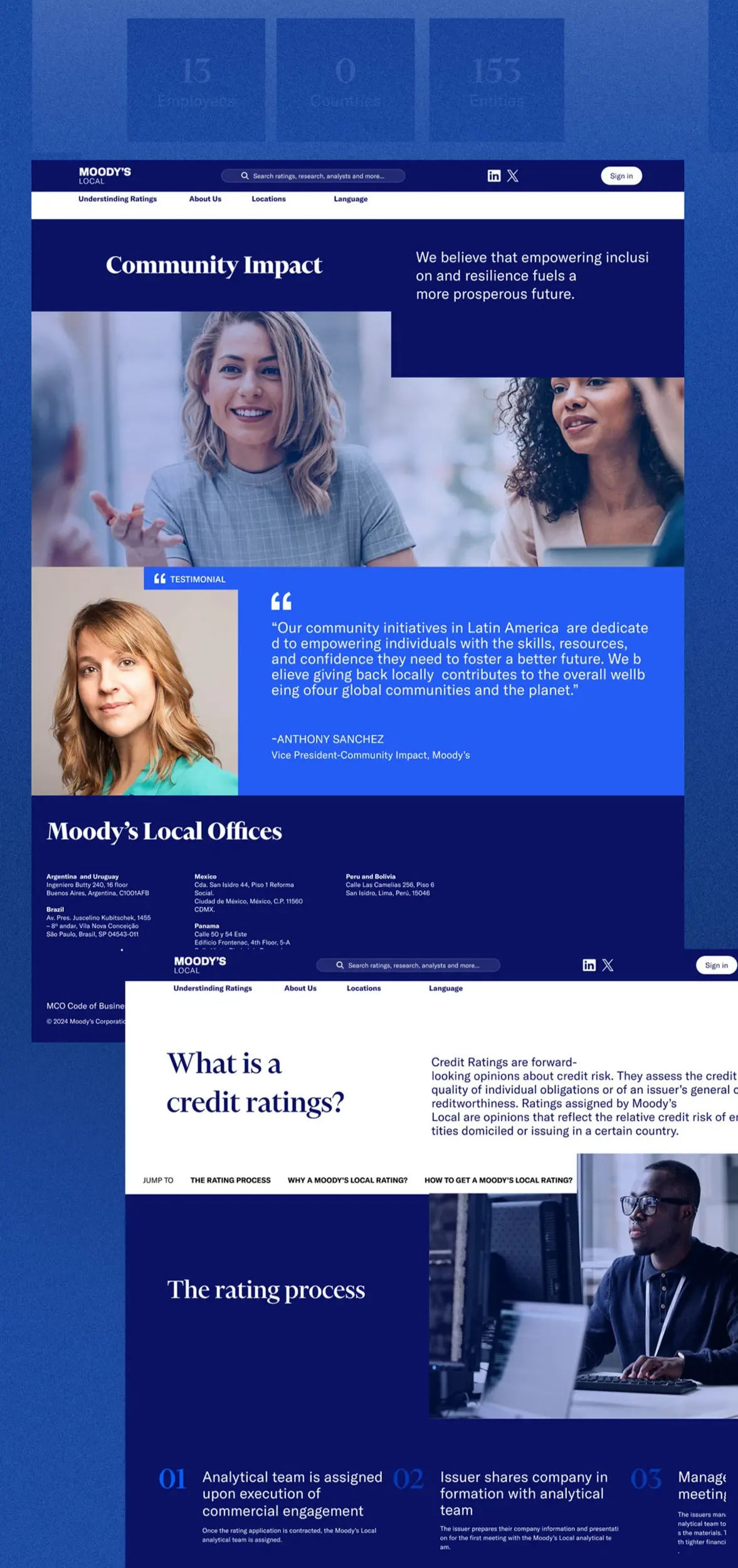
Discovery began by auditing Moody's global brand playbook, accessibility standards, and benchmarks across top-tier enterprise finance portals. We analyzed vanguard players in financial intelligence, credit markets, and strategic consulting to evaluate how dense datasets are organized to cultivate user confidence. Our strategy prioritized information architecture clarity, universal accessibility, strong visual hierarchy, and frictionless navigation—embodying Moody's commitment to analytical rigor, transparency, and forward momentum.
Creative Process
The design process adapted the updated brand manual into an extensible digital design system. Through iterative sprint cycles, layouts, modular grids, and navigation paradigms were systematically tested to strike an optimal balance between technical utility, aesthetic refinement, and effortless readability.
Design Decisions
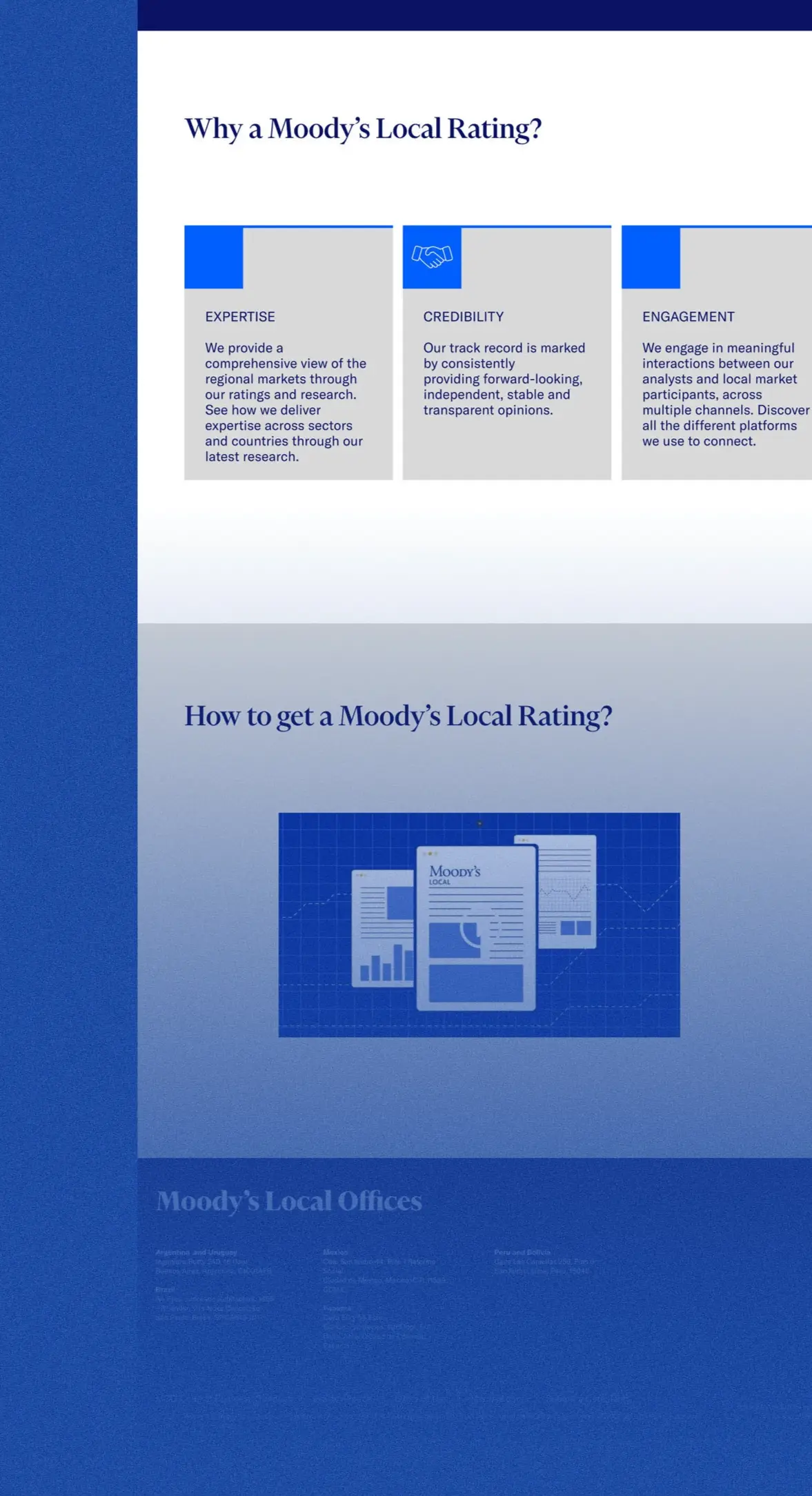
A modular, high-contrast grid was instituted to ease the consumption of complex financial intelligence. Brand-approved typography combined with strict typographic scale guidelines elevates content legibility and projects institutional gravity. The chromatic palette adheres to Moody's global blue spectrum to evoke institutional trust, stability, and authority. Intentional whitespace, reusable interface components, and flexible cards structure extensive content catalogs cleanly without visual friction. Every design choice reinforces a seamless, professional experience matching global enterprise benchmarks.
Tools Used
Figma Adobe Photoshop
Results & Impact
The project unified Moody's visual language across its Latin American digital ecosystem, presenting a unified, forward-looking presence aligned with global corporate positioning. The refreshed interface enhanced content discoverability, elevated institutional trust, and streamlined access to mission-critical financial analytics for institutional clients. Furthermore, the modular design system provides a future-proof foundation for subsequent digital rollouts across the continent.